
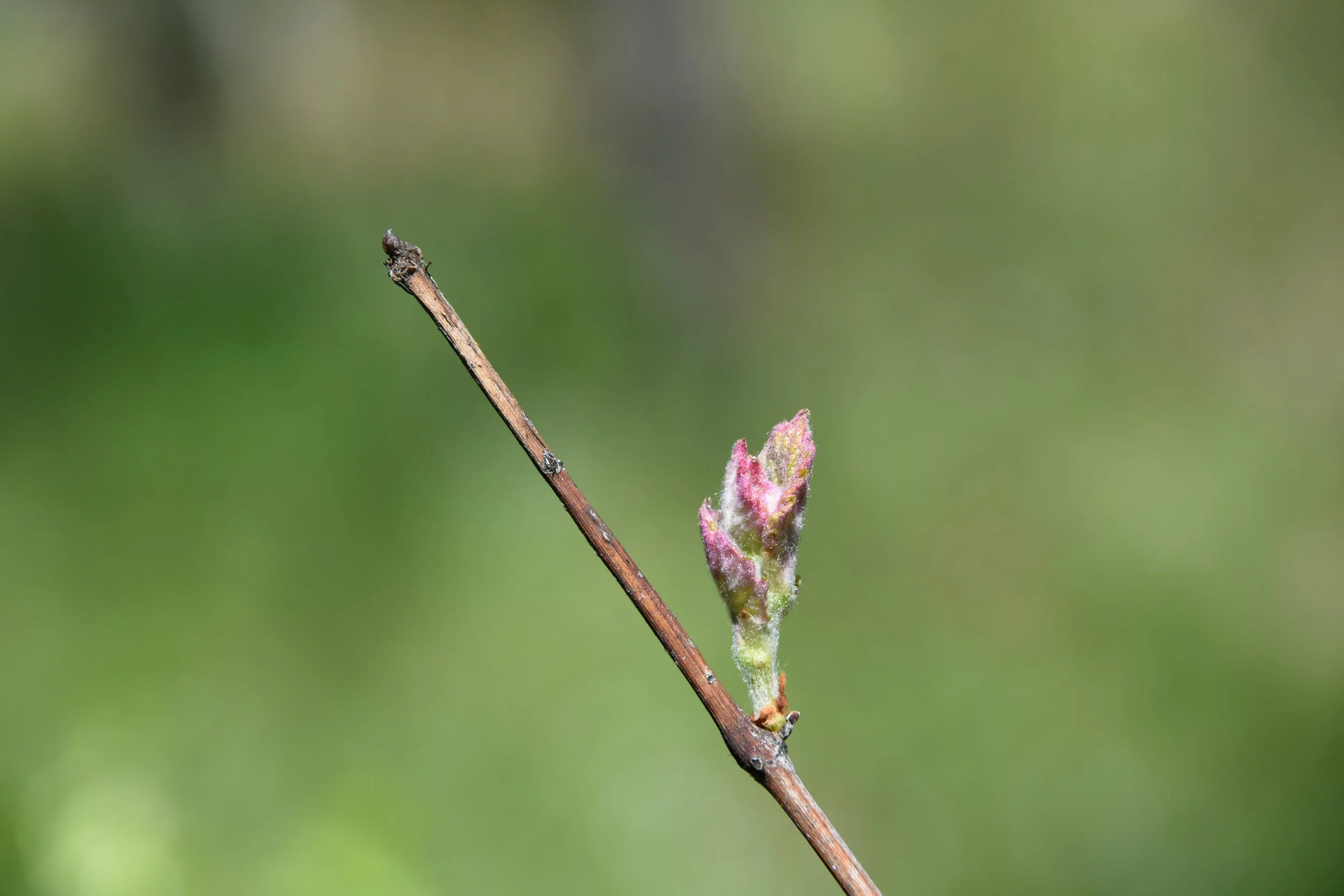
If you walk outside during the final weeks of winter, the trees look inert. Their branches are dark, rigid, and scratched against a gray sky. To the untrained eye, nothing is happening. It looks like stillness, or perhaps even death.
But if you look closer—right where the leaf met the stem the previous autumn—you will find small, tightly wrapped packages. These are buds. For months, they have carried everything needed to build a new canopy: embryonic leaves, miniature stems, and the beginnings of flowers. They are not dead. They are not even asleep. They are waiting for a precise combination of daylight hours and stable temperatures to signal that it is safe to open.
In viticulture and botany, the moment these packages burst open is called bud break. It is the official transition from dormancy to growth.
If you have spent a long season tucked away from the world—whether due to grief, illness, burnout, or a quiet period of personal rebuilding—bud break is a powerful template for your return. You might feel like you have fallen behind. You might worry that your time in isolation has broken your ability to connect, create, or participate in the rhythm of daily life.
You are not broken. You are not behind. You have simply been in a necessary winter, quietly gathering the energy required for your own next small, brave opening.
Returning to the world does not require a sudden, overwhelming explosion of activity. It can happen slowly, deliberately, and safely. One of the gentlest pathways for this return is through the lens of a camera. Photography allows you to look at the world before you have to step fully back into it. It offers a way to engage with reality at your own pace, one soft frame at a time.
1. The Necessity of the Dark Season
Our culture treats constant growth as the only acceptable state of being. We are expected to produce, socialize, and expand without interruption. When you find yourself unable to maintain that pace, it is easy to internalize a sense of failure. You look at others who seem to be moving forward smoothly, and you feel a distinct pressure to catch up.
Nature treats this rhythm differently. In temperate climates, dormancy is not an optional rest; it is a biological requirement. Without a period of chilling hours—a specific cumulative duration of cold temperatures—many plants cannot break their buds properly in the spring. If a tree remains warm all winter, its subsequent growth is erratic, weak, and prone to disease.
The cold is what prepares the plant to grow. The dark season is functional.
When you are tucked away, your mind and body are often doing invisible, heavy lifting. You are processing events, restoring depleted nervous system reserves, and integrating hard truths. This looks like inactivity from the outside, but it is an intensive expenditure of internal energy.
Consider what happens inside a winter bud. Cells are dividing. Plant hormones, specifically auxins and gibberellins, are shifting their balances. The plant is measuring the length of the nights, waiting for the exact moment the risk of a killing frost drops.
If you are currently resting, or if you are just emerging from a period of withdrawal, remind yourself that your stillness had a purpose. You were not wasting time. You were surviving the winter, keeping your core alive, and preparing your resources for the light.
2. Understanding Bud Break: Not a Fracture, But an Unfurling
The term "bud break" can sound violent if you take it literally. It implies a fracturing, a sudden tearing open under pressure. But when you watch the process through time-lapse video or daily observation, you see that it is actually an exquisite, gentle unfurling.
First, the hard, protective outer scales of the bud begin to swell. They separate slightly, revealing a soft, fuzzy interior often called "wool." Next, the green tips of the embryonic leaves peak through this woolly layer. Finally, the leaves expand, shake off the protective casing, and stretch toward the sun.
This is how you return to your life. You do not need to shatter your boundaries or force yourself into crowded spaces overnight. You do not need to prove your recovery by executing a massive project or making a grand social reappearance.
Your emergence can look like the wool stage: a slight softening of your outer shell, a willingness to look out the window, a brief text message to a trusted friend.
The goal is not to break yourself open. The goal is to allow your life to expand naturally as your energy returns. If you try to force a bud open with your fingers in January, you destroy the delicate structures inside. The leaf dies before it can ever meet the light. Trust that your timing is your own, and that a soft, gradual opening is the most sustainable way to rebuild your presence in the world.
3. The Camera as a Buffer and a Bridge
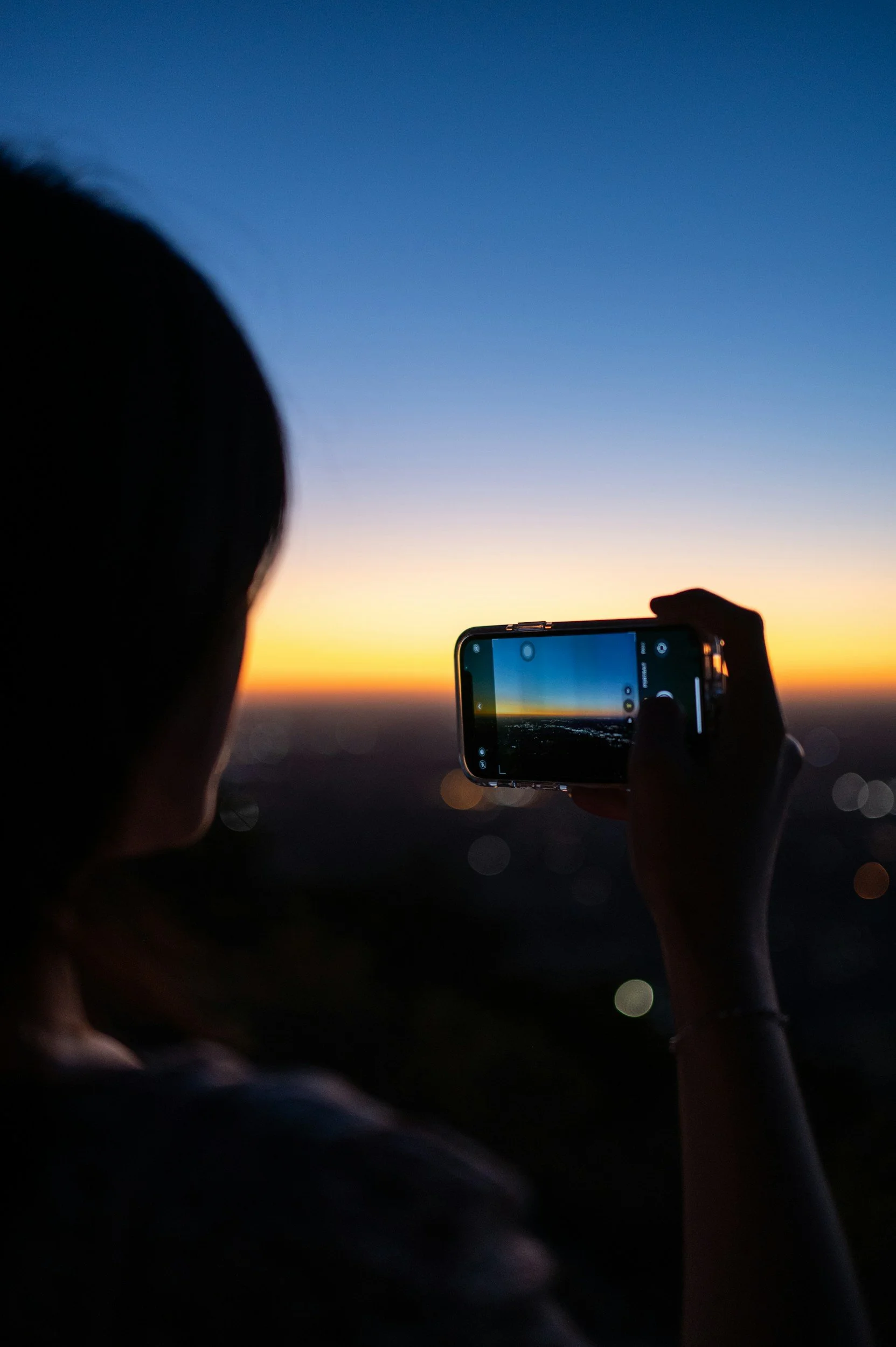
When your nervous system has been quiet for a long time, entering the world can feel sensory-rich to the point of pain. Voices sound too loud. Colors are too bright. The sheer volume of choices, movements, and demands can cause you to retreat right back into your shell.
This is where photography serves a therapeutic purpose. A camera—whether it is a dedicated digital body, an old film camera, or simply the phone in your pocket—functions simultaneously as a buffer and a bridge.
The Camera as a Buffer
When you look through a viewfinder or at a screen, you are placing a physical framework between yourself and the environment. You are narrowing your field of view. Instead of experiencing the entire weight of a park, a street, or a room, you are looking at a designated rectangle.
This framing reduces sensory overload. It gives your brain a specific, manageable task: evaluate this small space. Look at this line. Notice this texture. By focusing on a fraction of your environment, you filter out the noise of the rest. The camera protects you while allowing you to be present in a space.
The Camera as a Bridge
At the same time, photography forces you to look outward. When we are tucked away, our attention naturally turns inward. We become highly analytical of our thoughts, our grief, and our anxieties. This internal focus is necessary for a time, but eventually, it can become a loop that keeps us trapped.
A camera requires you to look for light, shadow, form, and movement outside of yourself. It invites you to observe without immediately participating. You do not have to talk to anyone to take a photograph of a leaf. You do not have to perform, explain your absence, or justify your current state. You are simply a witness. This witness role is an ideal middle ground between total isolation and full social engagement.
4. First Steps: Documenting the Close and the Mundane
You do not need to travel to an exotic landscape or a bustling city center to begin using photography as a tool for return. In fact, doing so would contradict the philosophy of bud break. Start where you are, within the boundaries of your current comfort zone.
Frame 1: Light on the Floor
Begin inside your own living space. Notice how the light changes throughout the day. Set an alarm for three different times—perhaps 8:00 AM, 1:00 PM, and 6:00 PM. When the alarm goes off, spend five minutes finding where the light lands on your floor, your wall, or a piece of furniture.
Take a photograph of that shape. Do not worry about making a beautiful image; focus on documenting the reality of the light. This exercise grounds you in the present moment and establishes a low-stakes routine of observation.
Frame 2: The Texture of Home
Move closer to the objects that have kept you company during your winter. The weave of your favorite blanket, the steam rising from a morning mug, the dust motes floating in a sunbeam, the spine of a book you read while resting.
Photographing these items honors your period of dormancy. It acknowledges that the tools of your comfort have value. You are documenting the environment that kept you safe while you were gathering your energy.
Frame 3: The View from the Threshold
When you feel a small spark of curiosity, move to the edge of your space. Stand at an open window or step onto your porch or balcony. Do not leave the property yet. Just look out.
Find something small within your view: a single leaf on a nearby bush, the pattern of water droplets from a recent rain on a railing, the way the neighbor's roof line meets the sky. Frame it, adjust your focus, and take the picture. You are extending your vision beyond your walls, testing the air, much like those green tips pushing through the woolly bud scales.
5. Moving Outward: The Low-Stakes Walk
Once you are comfortable observing from the threshold, you can take your camera on a low-stakes walk. The purpose of this walk is not exercise, socialization, or errands. The sole purpose is to find three things that interest your eyes.
Keep these walks short and predictable. A single block, a quiet path in a local park, or a turn around a quiet parking lot is sufficient. Go at a time when fewer people are likely to be around, such as early morning or mid-afternoon on a weekday.
As you walk, keep the camera in your hand or slung over your shoulder. This positions you as an active observer. You are no longer just a person walking through a space; you are a photographer on a quiet assignment.
Look for signs of transition in nature, as they mirror your internal process:
The cracked asphalt where a weed is pushing through.
The peeling bark of a birch tree, revealing smooth new wood underneath.
The gradient of color on a single blade of grass.
The way a puddle reflects the sky, turning a muddy ground into a patch of blue.
When you focus on these details, your perspective shifts. You stop thinking about how you look to others or how much energy you lack. Your mind settles into the simple calculus of composition: If I step two inches to the left, does the reflection become clearer? If I crouch down, does the leaf stand out against the background?
You are participating in the world through curiosity, which is the direct opposite of fear.
6. The Anatomy of a Small Opening
As you continue this practice, you will notice your internal landscape shifting. Just as the plant transitions through distinct morphological stages during bud break, your return will have its own structure.
Stage 1: Awareness without Action
This is the stage where you notice things again. For a long time during your winter, your surroundings might have felt flat or gray. When your awareness returns, you notice the crispness of the air, the sound of a bird, or the specific shade of a coat someone is wearing. You don't have to interact with these things yet; you just register their existence.
Stage 2: Low-Risk Exposure
This matches your short photography walks. You are out in the world, but you have an exit strategy. You have your camera to focus on, which gives you an authentic reason to avoid eye contact or conversation if you do not have the energy for it. You are gathering data, proving to your nervous system that you can step outside your home and return safely.
Stage 3: The First Small Connection
Eventually, your camera will invite a small interaction. A stranger might notice your camera and ask, "Did you find anything good to photograph?" Or a neighbor might comment on the morning light you are capturing.
Because you have been focused on an objective subject (the light, the plant, the architecture), you have something real and simple to say in response. You can point to the leaf or show them the back of your screen. The interaction is brief, centered on an external object, and requires no personal disclosure. It is a tiny, brave opening—a leaf tips poking through the wool.
7. Letting Go of Perfection and Comparison
One of the greatest risks to your recovery is the urge to compare your photographs—and your progress—to others. In the age of social media, it is easy to view photography as another arena for competition, another place where you must showcase a polished, impressive version of your life.
If you treat photography this way, it will lose its therapeutic power. It will become another chore, another reminder of the pressure to achieve.
To keep this practice safe and healing, establish a few ground rules for yourself:
Do not post your images immediately. Keep your photographs for yourself for at least a week. Let them be a private journal of your return, not content for public consumption.
Embrace technical flaws. An out-of-focus image, a blurry shot caused by a shaky hand, or an exposure that is too dark can be beautiful. These elements reflect your actual, human experience in the moment. They document your reality, which is far more valuable than a technically perfect, sterile image.
Focus on the process, not the product. If you spend thirty minutes outside and come home with twenty blurry, unusable photos, the walk was still a success. The success lay in the fact that you put on your shoes, stepped through your doorway, and spent thirty minutes looking closely at the world. The images are just the footprint of your movement.
8. Embracing Your Own Rhythm
Plants do not all break their buds on the same day. Even on the same branch, the bud at the tip—the apical bud—often opens days or weeks before the lateral buds lower down. Varietals planted in the exact same soil will emerge at different times based on their genetic makeup and their unique experience of the winter cold.
A Chardonnay vine breaks its buds early, risking the spring frosts. A Cabernet Sauvignon vine waits much longer, remaining dormant until the heat of late spring is guaranteed. Neither vine is wrong. Both produce fruit. Both fulfill their purpose in their own time.
You are no different. Your timeline for returning to your full life cannot be dictated by a calendar, an employer's expectations, or the social schedules of your peers. If you need more chilling hours, take them. If your bud break looks like a microscopic shift rather than a green explosion, honor that shift.
You have been tucked away for a reason. The walls you built around yourself during your winter were not a prison; they were the protective scales of your bud. They kept your core safe while the wind was howling.
Now, as the seasons shift, you are allowed to open. You don't have to rush. You don't have to carry any shame about the time you spent in the dark. Bring your camera, step to the threshold, look for the light, and allow yourself your own soft, small, brave opening.